



Key TakeawaysHide
- Check the employer, the exact programme and the grant approval separately.
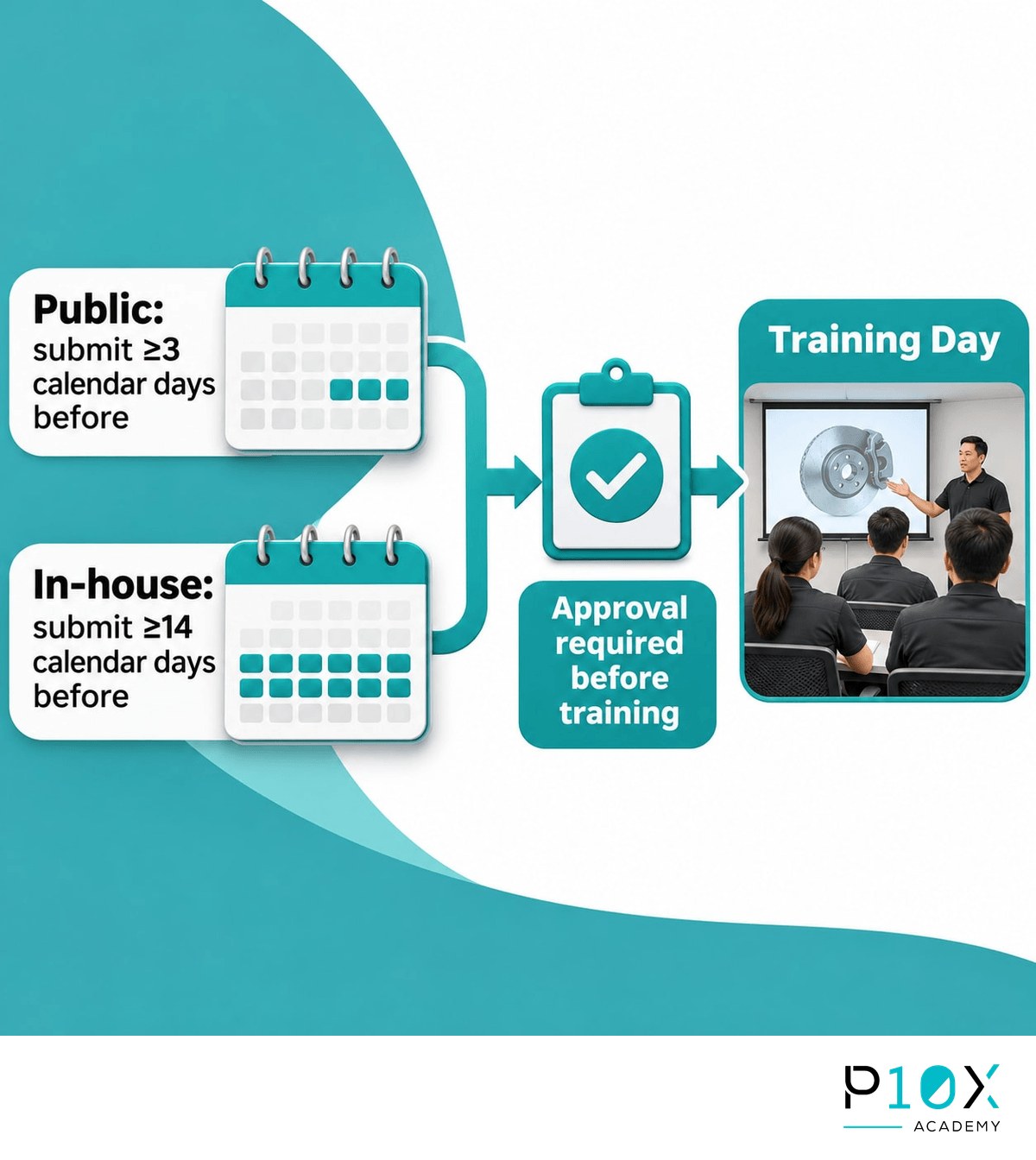
- Public training needs at least three calendar days’ notice; in-house training needs 14, counted from submission. Approval must come before training.
- Under HRD Corp Claimable Courses (HCC), the provider claims the course fee; expenses paid by the employer follow separate claim arrangements.
- Keep accurate attendance and claim records; a course advertisement is not a funding guarantee.
Your workshop may be able to claim HRD Corp funding for a detailing course, but an advertisement alone does not mean your workshop qualifies. Your business must be eligible, the exact programme must qualify, and HRD Corp must approve the grant before training.
Even when a course is advertised as HRDF claimable training, the provider cannot promise approval of your grant. The course should also teach the skills your employees need, rather than simply carry a claimable label.
Check your workshop’s eligibility before booking
Under the Pembangunan Sumber Manusia Berhad Act 2001, covered employers with 10 or more Malaysian employees must register and contribute 1% of qualifying monthly wages. Those with five to nine Malaysian employees may register voluntarily at 0.5%, according to HRD Corp’s employer registration FAQ. HRD Corp decides whether your business is covered.
If your workshop has not registered with HRD Corp, you can check whether it needs to register before booking, rather than assuming registration can be sorted out later. If you are already registered, the person who manages your account in HRD Corp’s eTRIS online system can check for outstanding HRDF levy payments.
Your workshop needs three separate checks: employer eligibility, the exact programme and grant approval. Registration and levy payments affect the employer check, but they do not approve the course or grant. Being an automotive business or wanting to train staff does not automatically make your workshop eligible.

Next, look at existing training commitments as well as the balance shown in the account. A balance does not mean a new application has been approved, and it does not establish that every item on a quotation is allowable.
Finally, identify who will attend and why the training is needed for their work. You are applying as an employer to train your staff, not asking for a personal course discount. If an owner or director wants to attend, confirm their eligibility under the relevant scheme rather than assuming ownership is enough.
Check what the detailing course actually teaches
A current course outline gives you more to compare than a poster saying “detailing training”. The outline should show the subjects, practical work and schedule, so you can compare them with the tasks your employees need to learn. Check that the quotation refers to the same programme and intake.
At P10X Academy, our Car Detailing: 3-Day Technical Experience Course introduces detailing products, paint and interior materials, washing methods and beginner polishing. Our published schedule moves from product knowledge on the first day to interior and exterior washing on the second, then beginner one-step bonnet polishing on the third.
Day one also distinguishes a conventional car wash from professional detailing and introduces soaps, maintenance products, removers and degreasers. Day two covers how automotive paint and interior materials are constructed, alongside washing steps and precautions. Polishing is scheduled for day three; the course is not three full days of polishing practice. If your team mainly needs help with washing or product knowledge, you can discuss how the earlier parts of the course address those tasks.
Our three-day course covers beginner skills. Completing it does not mean employees will be ready for advanced paint correction, coating work or every type of interior repair. If your staff already know the basics, you can ask us for a current course outline covering the skills they need next.
Beginners need to understand the products, recognise different surfaces and learn the precautions before focusing on speed. You can ask how demonstrations and supervised practice are organised, what each participant will do and how the trainer will check their understanding.

Our published course page describes what we teach; it is not approval of your grant. Confirm the exact programme’s current registration, the training dates and the proposed arrangement with the provider before you rely on the claimable label. Keep the course outline with your quotation so both the workshop and the trainer are working towards the same learning goals.
Which staff would benefit from the course?
Your staff’s daily tasks can help you decide who should attend a course. Supervisors can identify where each employee needs guidance, and the provider can compare those needs with the syllabus before preparing a quotation. A convenient course date should not be the only deciding factor.
These tasks might include identifying interior materials before cleaning, choosing products that suit each surface, or following a consistent washing sequence.
Our published course entry requirements say no prior experience is needed and participants should be at least 18. That makes the course an option to discuss for adult staff who are new to detailing. Course entry requirements and HRD Corp participant eligibility are different checks: meeting the age requirement does not establish that an owner, director or employee qualifies for funding.
The provider can explain which of those tasks are covered in the proposed course and which are not. If the main problem is outside the syllabus, a different course may be more suitable. Changing the wording of a grant application does not change what the course teaches.
Detailing training can cover paint and interior materials, washing techniques and polishing. The subjects in a promotional reel may not match your staff’s proposed course, so you can compare the skills your staff need to learn with the current written syllabus. A reel does not show that a session was funded by HRD Corp or replace the programme details needed for a grant application.
When to apply for public and in-house training
Under Employer Circular 4/2026, dated 4 November 2026, public training grant applications must be submitted at least three calendar days before the scheduled start. In-house applications must be submitted at least 14 calendar days before the start. The public-training arrangement has been extended through 31 December 2027.
Confirm whether the proposed course is classified as public or in-house training before choosing the application date. The latest official notice distinguishes these categories. Do not decide the category solely from whether the course takes place at our Academy or inside your workshop.
The circular counts the period from application submission. It also says training may proceed only after approval has been obtained. Meeting the minimum submission period is therefore not permission to send employees while the application remains pending.
Allow additional time for your own checks, missing documents and questions from HRD Corp. Ask the provider when it can supply the final quotation, schedule and trainer information, then work back from the intended training date. Do not arrange staff cover around an assumed approval date.
Older webpages and saved guidance may describe a different notice period or say that the public-training concession ends in 2026. Use the newer circular for this point and confirm any later changes before the intake. If dates, participants or delivery arrangements change after submission, check the required action with HRD Corp and the provider before proceeding. Do not assume an existing approval automatically covers a revised booking.
Separate the course fee from other costs
Ask for an itemised quotation and identify which costs belong in the grant application. The course fee is not the same as the total cost of taking staff away from the workshop. Travel, accommodation, meals and other items each need their own eligibility checks where applicable.
Check the course against your team’s needsExplore the Car Detailing: 3-Day Technical Experience Course, then ask us for the current outline, quotation and programme information for your employer’s grant checks.
HRD Corp’s Allowable Cost Matrix sets out the relevant cost categories and conditions. Whether an expense can be claimed depends on the scheme, training arrangement and applicable limits. A receipt proves that money was spent; it does not automatically make the expense allowable.
Our three-day course page says the tools, detailing products, consumables and training vehicles are provided. You can compare that with the quotation before setting aside money for separate purchases. An item being provided for the class does not mean your workshop needs to buy it afterwards or that a separate purchase would qualify for a training claim.
Under HRD Corp Claimable Courses, the provider submits a claim for the course fee after training. HRD Corp pays the provider once that claim is approved. That arrangement differs from a scheme in which an employer pays a fee first and seeks reimbursement. Before accepting payment instructions, you can confirm which grant scheme is being proposed and who is expected to pay each item.
Your workshop may still have costs it needs to pay itself. For example, staff cover or a purchase for normal workshop operations should not simply be bundled into a training claim because it appears useful. Check any proposed training materials against the actual scheme rules instead of treating tools and consumables as universally claimable.
When comparing quotations, compare the same training content, delivery arrangements and included items. The cheapest course may not teach the skills your staff need, and a higher quotation does not mean HRD Corp will approve a larger grant. Base the decision on the approved items and conditions, not a promise that training will have “no cost”.

Get the documents that match your booking
The application should use the agreed course details, schedule and quotation. HRD Corp’s claimable-course guidance lists supporting material such as the quotation or invoice, training schedule and content, and trainer profile. Check the current requirements for your chosen scheme before submitting.
Start with the provider’s details and the exact programme name. Ask us to help you verify the programme information, including its current registration and the arrangement being quoted. Do not rely on a logo in a social post as your only check.
Then compare the documents with the booking. Are the dates consistent? Does the quotation cover the intended participants and delivery format? Does the outline include the practical work you discussed? If the workshop expects beginner bonnet polishing, the training documents should not quietly describe a different course.
Keep the submitted versions together, along with the grant decision and any later correspondence. Assign someone at the workshop to track questions and document requests. The provider may help prepare information, but that assistance is not a guarantee of approval or a substitute for checking the employer’s own application.
Trainer information matters for both the application and the learning. A clear trainer profile and course schedule help you understand who will teach the group and how the time will be used. For practical subjects, ask how the trainer will demonstrate the task, watch participants practise and correct their technique. For bonnet polishing, ask how the trainer checks pad placement and guides participants during practice.
Keep attendance and check what staff learned
Arrange the training records before the course starts, then check that they reflect what actually happened. The cost matrix describes claim evidence that can include attendance records and the relevant joint declaration. The required documents depend on the scheme and claim being made.
Ask the provider who will prepare each record and who at your workshop must check or sign it. Do not sign an attendance statement in advance, include an employee who did not attend, or assume that the original booking list proves completion. If someone misses part of the training, ask how that affects the claim rather than submitting the planned attendance unchanged.
Keep learning checks separate from funding checks. A signed attendance record helps document participation; it does not prove that a person can safely perform every detailing task. Equally, a good practical result does not replace the records HRD Corp requires.
After the course, returning employees can demonstrate the agreed tasks within their competence so a supervisor can see where they still need practice. A supervisor can check the sequence, product choice and precautions, then decide whether more practice or further training is needed.
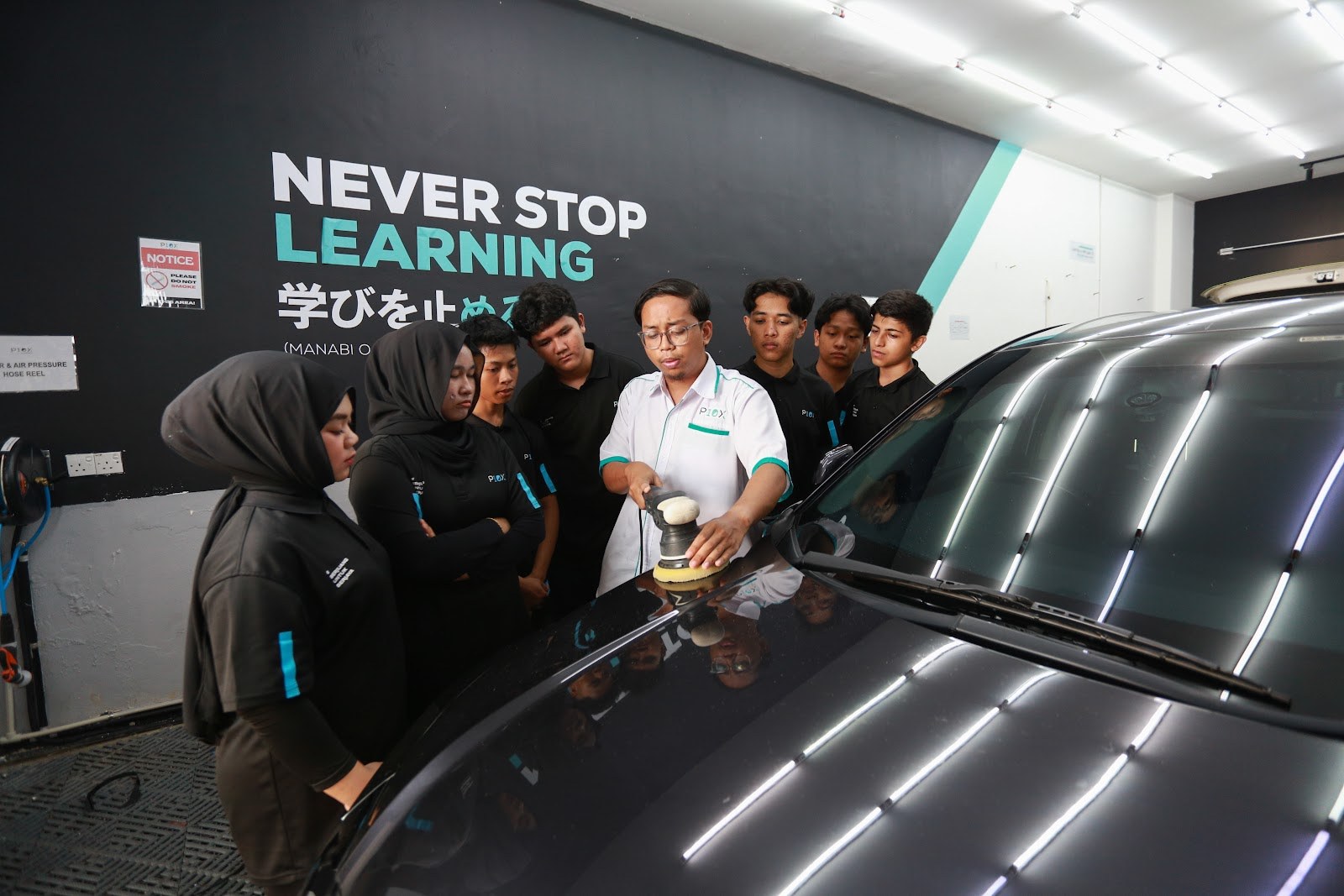
Our three-day course includes practice on real vehicles at our Bandar Sunway facility and a P10X Academy Certificate of Completion after assessment. That certificate is not an SKM (Sijil Kemahiran Malaysia) qualification. When discussing the course, you can ask what the assessment checks and what feedback participants receive, so the supervisor knows which tasks to revisit at work.
We share recordings of practical assessments, but assessment methods vary by programme. Footage from another programme does not tell you how your staff will be assessed, so you can ask us how learning is checked in the course you are considering.
Submit the right claim after training
After training, check the approved grant against the actual attendance, invoices and allowable expenses. The HRD Corp Claimable Courses (HCC) guidance says claims must be submitted within six months of training completion. Treat that as an outside limit, not a reason to leave missing records until the last week.
Confirm which claim the provider submits and which expenses, if any, the employer must claim. Keep copies of the supporting documents and respond to queries through the proper process. Do not promise the finance team a fixed reimbursement date: submission, review and payment are different stages.
If the final expense is below the approved amount, approval is not a right to claim the unused difference. If a cost is higher or differs from what was approved, check the applicable rules rather than assuming it will be covered. Keep the workshop’s own payment records separate from the grant approval so both can be reconciled.
What to confirm before staff attend training
Before booking training, your workshop needs to confirm employer eligibility, the exact registered programme and grant approval before training. You also need to know who pays each cost and who keeps the attendance and claim records, so those responsibilities are clear before staff attend.
If any point is unclear, resolve it with HRD Corp or us before proceeding on the assumption that funding is secured. A useful next step is to send us your staff’s current experience, the skills you want them to learn and the proposed dates, then request the exact course information for your employer’s application.