



Key TakeawaysHide
- “Claimable” is conditional, not a promise of free training or a personal refund.
- Check the employer, exact programme and approved grant separately.
- Eligible costs and limits depend on the scheme; a quotation or receipt alone is not enough.
- Under HRD Corp Claimable Courses (HCC), the provider claims the approved course fee.
- Apply in time and obtain approval before the course begins.
“HRDF claimable” usually means an eligible employer can apply to fund approved training through HRD Corp, subject to the scheme’s conditions. It does not mean every attendee gets a personal refund, every course expense is covered, or the provider can guarantee your application will succeed.
Before booking corporate training, separate three questions: Does the employer qualify? Does this exact programme qualify? What has HRD Corp approved for this training? Once those are clear, you can work out the likely payment arrangements and any costs the business needs to bear itself.
What is claimable under HRDF?
Under HRD Corp Claimable Courses, training is intended to retrain or upgrade employees’ skills in line with business needs. The scheme covers public and in-house training arrangements, subject to its conditions. A provider’s registration does not mean your chosen course or your employer’s grant has been approved.
Before applying, check your employer’s HRDF levy payments, registration and any unresolved account issues. HRD Corp can confirm what needs to be corrected. Paying the levy does not mean the grant for your booking has been approved.
Next, identify the actual programme and intake. A provider may offer several courses, and the same broad subject can have different levels, durations or delivery arrangements. Ask for the information that matches your proposed booking, including the current programme status and quotation.
An employer’s eligibility, the exact programme and grant approval are separate checks. The grant decision shows the training, participants, dates, allowable costs and conditions that have been approved. An acknowledgment only confirms that the application was received, not approved. Grant approval does not mean the claim has been paid. The business may still have costs to pay itself.

Which courses fit an employer’s training needs?
Start with the work employees need to do better. A course should address a real skill or knowledge gap, not simply appear on a list labelled claimable. HRD Corp’s HCC scheme describes training linked to business needs and sets a minimum training duration of four hours, alongside its other requirements.
For an automotive business, the need might involve technical work, supervision or another part of running the operation. The employees’ actual work can help narrow the course choices. Programme eligibility still needs to be confirmed under the intended scheme.
A specific task and a list of the employees who need to learn it make course outlines easier to compare. For example, “choose a cleaning product for different interior materials” gives a provider more to work with than “send staff for detailing”.
Then look at the participants’ starting level. Beginners and experienced technicians may need different training, even when both work in the same bay. A short introduction may help one group but repeat what another group already knows. Ask the provider to explain the level before agreeing on the participants.
For practical training, it helps to plan how employees will use what they learn when they return to work. You can agree who will supervise their practice and what that person will check. A briefing beside a vehicle can introduce a task, but the workshop still needs to agree what staff will practise and how their understanding will be checked. For staff attending a detailing course, the syllabus needs to match the tasks they will do.

Check the provider and programme separately
Check both who provides the training and what programme you are booking. A provider’s registration does not settle whether a particular course, intake or delivery arrangement meets the requirements of your employer’s proposed grant. Ask for current information that can be checked against the application.
HRD Corp’s HCC application guidance lists the quotation or invoice, training schedule or course content, and trainer profile. These documents answer different questions. The quotation identifies the proposed charge, the schedule or outline explains what staff will study and when, and the profile identifies the person who will teach them. Comparing all three helps you spot a booking that has the right course name but different dates, content or trainer information. If different names or dates appear across the documents, resolve the mismatch before submission rather than assuming the approver will know what you intended.
At P10X Academy, we offer HRDC Claimable Corporate Training as a registered training provider. Our provider registration is not a grant decision for your company. Ask about the programme that fits the actual training need, then confirm the applicable scheme and conditions.
Keep the provider’s answers with the other booking documents so the person preparing the application can check them. If a sales description promises that training is fully funded, ask what that means for this employer, this course and each proposed cost. Do not treat a broad marketing statement as a commitment by HRD Corp to approve or pay your claim.
Social posts can give you an idea of what a provider teaches and how it teaches. They do not replace a check of the programme you plan to book. Our training reel introduces courses for different skill levels. For your booking, what matters is whether the current course outline covers the skills your staff need, not whether the video uses the word claimable.
What expenses can an employer claim?
Course fees and other training expenses may qualify, but the allowable items and limits depend on the scheme and training arrangement. HRD Corp’s Allowable Cost Matrix is the place to check the category, conditions and evidence required. It is not enough that the expense appears on a provider’s quotation.
For each proposed expense, ask three practical questions: Is it permitted for this arrangement? What limit applies? What evidence must be kept? A receipt shows what was paid; it does not prove that the expense qualifies. Likewise, a provider’s package price does not establish how much of that package HRD Corp will approve.
Avoid bundling ordinary business purchases into a training budget without checking the rules. Buying equipment for everyday operations does not automatically make it a training expense. If consumable materials are proposed for the course, verify how the matrix treats them and whether additional information is needed.
Keep employer-paid items separate from costs the provider will claim. This helps the finance team understand what the business needs to pay and which documents it must retain. It also prevents duplicate claims for the same item. Where an expense is unclear, ask HRD Corp before committing to it rather than relying on a later appeal or assuming an invoice will be sufficient.
Discuss the training your team actually needsExplore our HRDC Claimable Corporate Training and ask for programme details that match your staff’s work. Confirm the exact course and scheme, and obtain HRD Corp’s grant approval before treating any cost as funded.
A cost breakdown can separate the course fee from meals, travel, accommodation, venue rental and any proposed training materials. The HRD Corp Claimable Courses (HCC) guidance describes eligible categories, subject to the matrix and relevant conditions. That does not make every item in every category claimable for every course.

How much can an employer claim from HRDF?
There is no single amount that applies to every employer or course. The amount depends on the grant scheme, allowable limits, the employer’s account status and the grant approval. The final claim must also reflect actual eligible expenses. A larger levy balance is not permission to claim every cost on a quotation.
For general public courses held in Malaysia for employees from more than one organisation, the January 2026 Allowable Cost Matrix sets a course-fee ceiling of RM1,750 per participant for a seven-hour training day. Financial assistance for public training is limited to nine trainees per employer. For public certification programmes, assistance may instead be considered for the actual number who attend.
For general in-house courses attended by employees from one organisation, the full-day ceiling is RM10,500 per group for at least seven training hours. The minimum group is two trainees for face-to-face training or one for remote online training. Below five trainees, work out the full-day fee ceiling at RM2,100 per trainee (RM10,500 divided by five), rather than using the full RM10,500 group limit. In-house groups are limited to 50 trainees for soft skills courses or 25 for technical courses.
These are category-specific fee limits, not automatic approvals or limits for every type of course. The quotation should identify the category, delivery arrangement, duration and participant count so you can compare it with the correct limit.
Check which costs the grant approval covers and any conditions attached, not just the total amount. Keep the final attendance and expense records consistent with what actually happened. If a booking changes, find out what action is required before treating the original approval as permission for the revised arrangement.
Payment arrangements also vary. Under HCC, the course fee is paid to the provider after claim approval, rather than reimbursed to the employer. Under other schemes, the employer may pay first and then claim reimbursement for costs allowed under the scheme. The cost matrix distinguishes these arrangements, so ask which one is being used.
For budgeting, keep a separate list of costs the business may need to bear itself. Do not tell managers the course is “free” just because the provider uses the word claimable. When budgeting for the approved training, you can allow for any employer contribution and the time employees will spend away from their usual work.
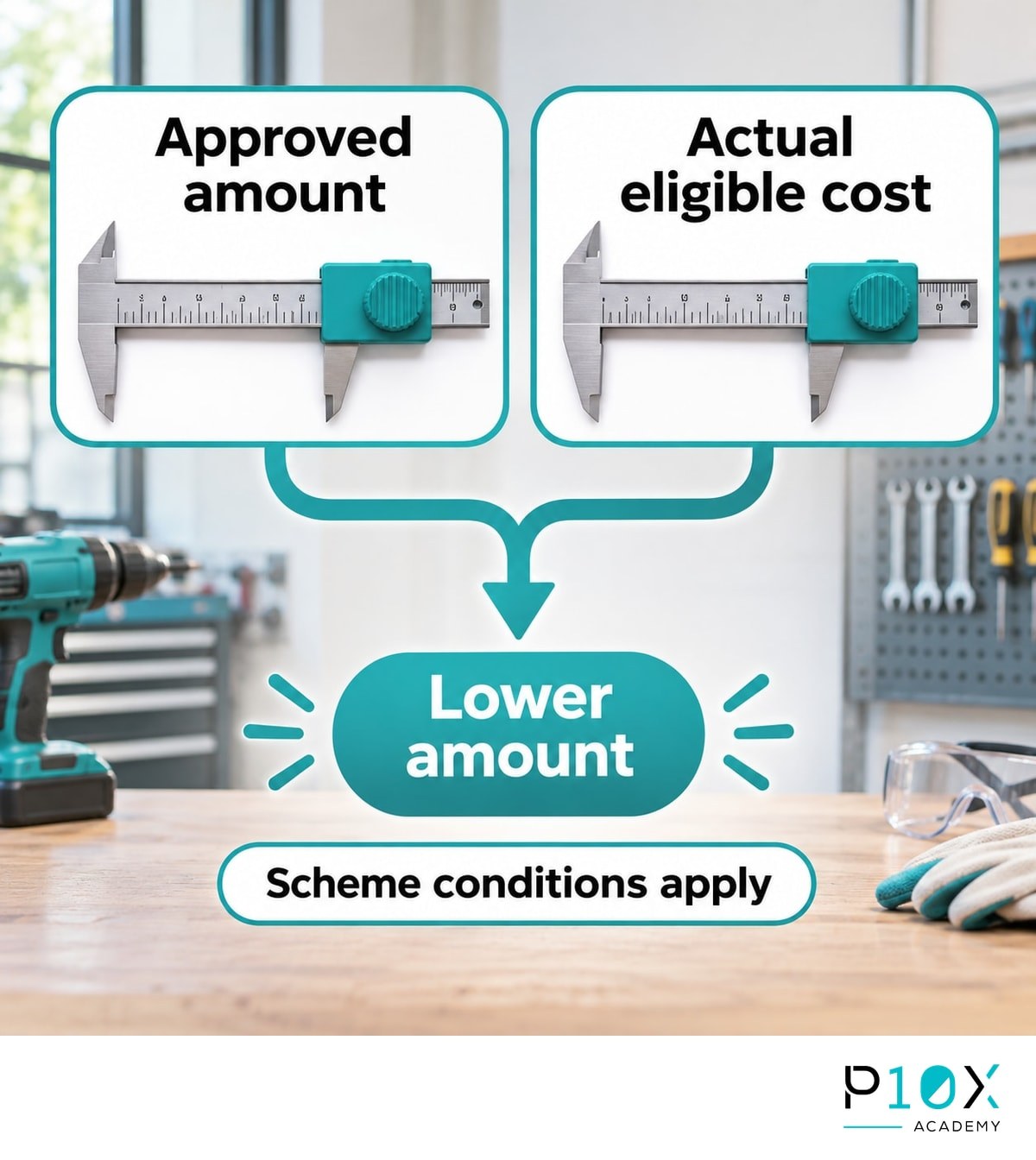
HRD Corp’s employer FAQ explains that reimbursement is based on the approved amount or actual eligible expense, whichever is lower. If the actual cost is lower, you cannot claim the unused difference. If the actual cost is higher, do not assume HRD Corp will approve the extra cost.
Check the practical value before comparing fees
A course can meet funding conditions and still be a poor match for the employees attending. Compare what participants will learn and practise before deciding which fee offers better value. Ask how much time is spent explaining the task, demonstrating it and letting participants try it with feedback.
For example, our three-day detailing course covers product knowledge, paint and interior materials, washing precautions and beginner one-step bonnet polishing. These topics can help you decide whether this introductory course suits your staff. They are not evidence that participants will learn advanced paint correction or receive an SKM (Sijil Kemahiran Malaysia) qualification.
If experienced staff already perform the listed tasks, discuss a more suitable level rather than booking an introduction simply because it is available. If beginners need that introduction, ask what practice and supervision they should have after returning to work.
Our course page also states that tools, washing and detailing products, consumables and real training vehicles are provided. You can ask which of these resources each participant will use and which activities they will carry out themselves.
For interior cleaning, ask how the trainer teaches participants to recognise materials and choose a suitable working method. A demonstration alone does not show how much individual practice your group will receive. Ask how the class is organised, what each participant will do and how the trainer will respond if someone needs more guidance.

Keep learning evidence separate from claim records
Keep both, but do not confuse their purpose. Attendance and the required declarations support the funding claim. Observing an employee perform a task helps the business judge what they learned. One does not replace the other, even when the training includes a practical assessment.
The Allowable Cost Matrix describes the relevant claim documents, which can include attendance records, invoices and a joint declaration, depending on the scheme and claim. Confirm who prepares each document, who checks it and who submits it. Keep copies of the records the employer is responsible for.
Attendance records must show who actually attended. If an employee misses training, do not carry the original booking list into the claim as though everyone completed it. Ask how the change affects the required evidence and allowable amount. Similarly, do not sign declarations before the events they describe have taken place.
You and the supervisor can agree how to check what employees learned. Employees might demonstrate a taught task, explain a precaution or show how they choose a product. Use those checks to decide what further practice staff need. They do not replace official claim documents or guarantee a business result.
We share footage of practical assessments, but assessment arrangements vary between programmes. The footage is not evidence of grant approval. You can ask what the selected programme includes.
Apply early enough and obtain approval first
Use the current notice period for the proposed training category. Employer Circular 4/2026, dated 4 November 2026, requires public training applications at least three calendar days before the scheduled start and in-house applications at least 14 calendar days before it. The public arrangement extends through 31 December 2027.
The period runs from application submission, and approval must be obtained before training proceeds. Submitting by the minimum deadline does not mean HRD Corp will approve the application before the course starts. Leave time to gather documents and answer questions, and verify the classification rather than guessing from the venue.
After training, HRD Corp Claimable Courses (HCC) guidance requires claims within six months of completion. Confirm the current documents and responsibilities for your claim. Older guides can be useful for understanding the portal, but the newer circular governs the advance-notice point above.
Confirm the conditions before committing your budget
Before confirming the booking, check the employer account, exact programme, quotation, training dates, grant approval and payment responsibilities. Make sure the people arranging the course and those processing payments have the same information. If any item remains uncertain, resolve it with HRD Corp or the provider before assuming it will be funded.
The most useful next step is not to ask whether a provider is “HRDF claimable” in general. Ask whether this programme, for these employees and dates, can be submitted under the right scheme, and what your business would still need to pay.