


Key TakeawaysHide
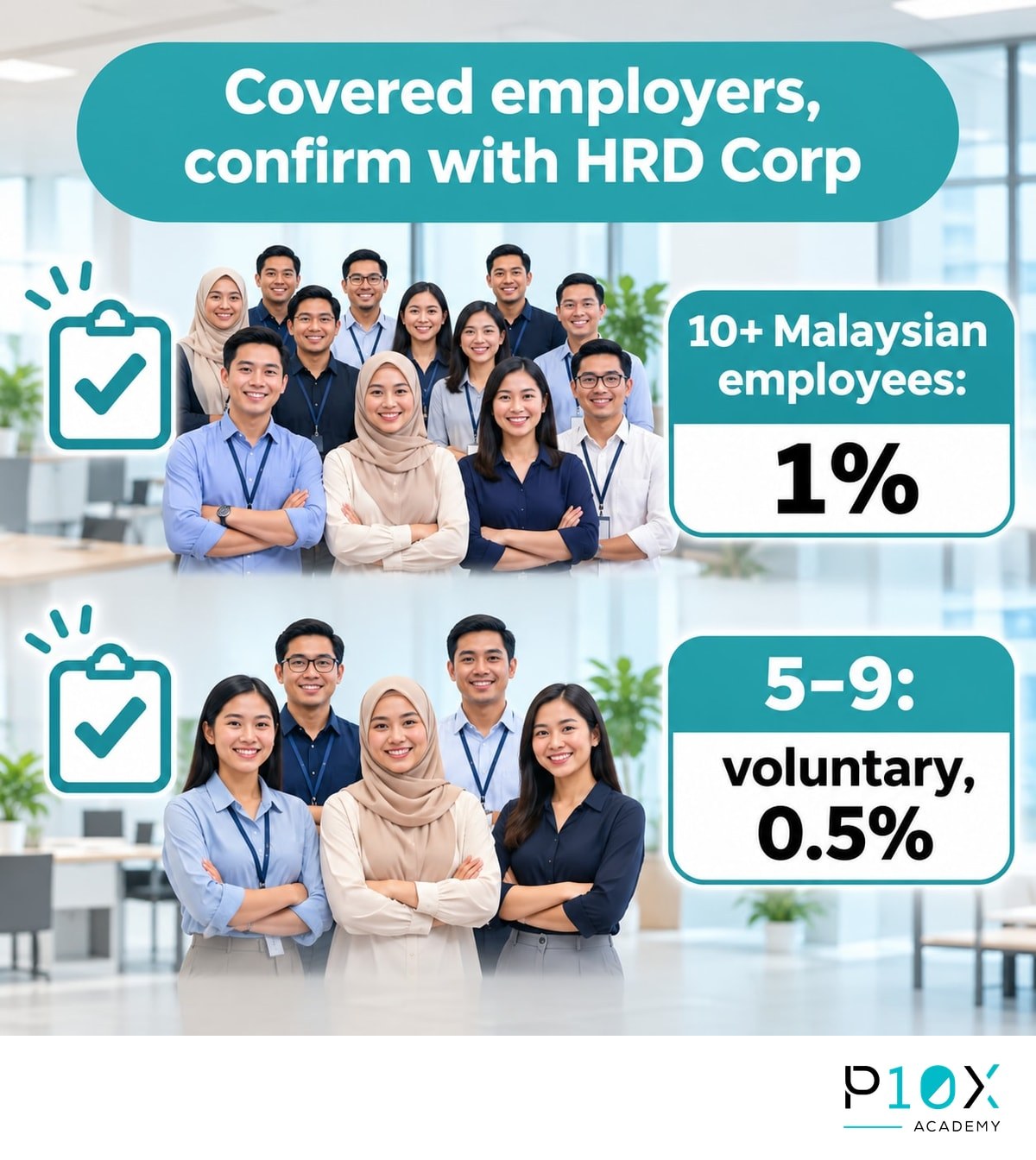
- Covered employers with 10 or more Malaysian employees normally contribute 1%. Covered employers with five to nine Malaysian employees may register voluntarily at 0.5%.
- Calculate the levy on qualifying wages, not automatically the whole payslip.
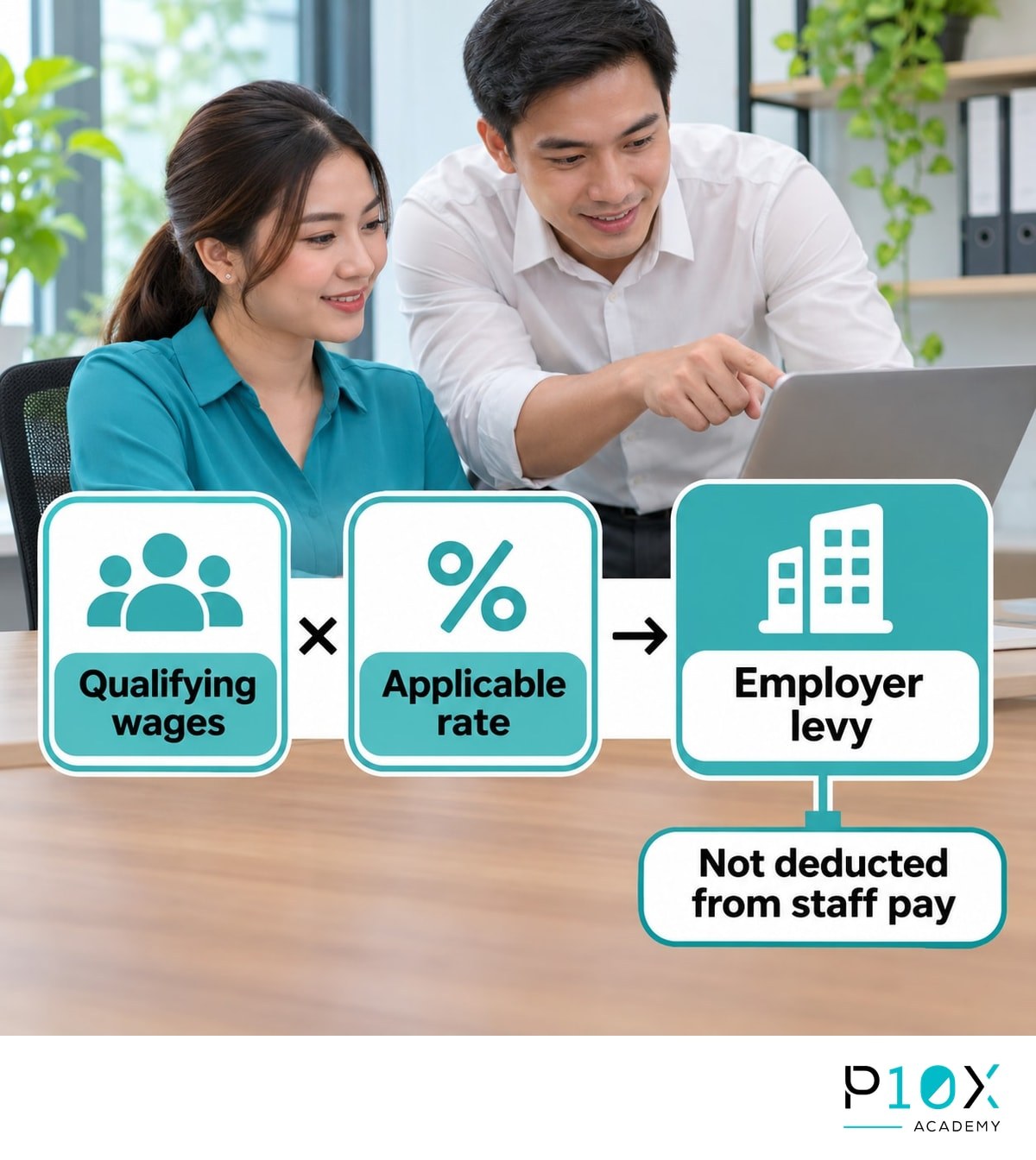
- The levy is an employer cost and must not be deducted from staff pay.
- Pay by the 15th of the following month and check that the payment is recorded in the correct employer account for the correct salary month.
- Levy balance and grant balance are different figures. Neither means a course has been approved.
Production referencesProduction references: Academy training photos and reels
Retained training assets for production reference only. This group is separate from the reader-facing levy article and is not for publication as part of its body.
Academy instructor briefing trainees. This photo is a training reference, not evidence of an employer’s levy or grant position.
Real Photo Bank photo (P10X Academy)Alt text: A P10X Academy instructor briefing trainees beside an open car bonnet.
File name: p10x-academy-instructor-briefing-trainees-beside-open-bonnet-dsc00001.JPG
Photo Link: https://drive.google.com/file/d/1k9X8mTzC5ojagME-ZoLQy_7qlfPeyJDR/view?usp=drive_link
Academy short-course reel. It introduces training topics, not approval of a selected course, participant or grant.
Social video (IG reel)Academy instructor coaching a washing session. This photo is a training reference, not evidence of a levy transaction.
Real Photo Bank photo (P10X Academy)Alt text: A P10X Academy instructor guiding trainees as they wash a car.
File name: p10x-academy-instructor-coaching-trainee-washing-front-wing-6268.jpg
Photo Link: https://drive.google.com/file/d/1K3DE70_ye2LLJSof1a10Sdz4bchbcz9L/view?usp=drive_link
Academy practical-assessment reel. Programme arrangements differ; it does not establish the assessment, qualification or funding of the selected short course.
Social video (IG reel)
Employers pay the HRDF levy towards employee training. It must not be deducted from staff salaries. For employers covered by the Pembangunan Sumber Manusia Berhad Act 2001 (PSMB Act), the usual rate is 1% of qualifying monthly wages when there are 10 or more Malaysian employees. Covered employers with five to nine Malaysian employees may register voluntarily at 0.5%.
Paying the levy and receiving a training grant are separate steps. Your HRDF claimable training application still needs approval. We can discuss corporate training programmes based on the skills your team needs, but HRD Corp decides whether the employer’s application qualifies.
Who has to pay the HRDF levy?
Covered employers with 10 or more Malaysian employees must register and contribute at 1% of qualifying monthly wages. Covered employers with five to nine Malaysian employees may register voluntarily at 0.5%. HRD Corp’s employer registration FAQ explains these thresholds; final coverage and registration decisions rest with HRD Corp.
| Employer position | Registration and usual levy rate |
|---|---|
| Covered employer with 10 or more Malaysian employees | Mandatory registration; 1% |
| Covered employer with five to nine Malaysian employees | Voluntary registration; 0.5% if registered |
Count Malaysian employees for the threshold rather than using the company’s total headcount without checking. A workshop with a mix of Malaysian and foreign staff should not assume that the number on its full staff list is the relevant figure. Likewise, a company’s foreign ownership does not, by itself, answer the registration question.
HRD Corp’s levy guidance describes an employee for this purpose as a Malaysian citizen working full time under a contract of service, whether permanent or on contract. A worker is not excluded merely because their employment contract has an end date. Equally, do not treat every person who sends an invoice to the business as an employee without checking the actual arrangement.
Salaried directors, owners or partners can fall within the employee definition. HRD Corp’s guidance excludes directors who receive fees only. If the headcount depends on one of these cases, confirm the position with HRD Corp rather than deciding from a job title alone.
Submitting Form 1 is not automatic registration. HRD Corp’s registration FAQ says eligibility is confirmed after it processes Form 1 and checks the supporting information and documents. A phone call or email alone does not confirm eligibility, so keep the formal registration outcome with the employer’s records.
Do not simply switch rates whenever a payroll list changes without checking what action is required for the employer’s registration. Keep the headcount and employment information current, and seek clarification if the business is close to a threshold or its circumstances have changed.
How is the monthly levy calculated?
Calculate the levy using qualifying wages and the rate that applies to the employer. HRD Corp’s levy calculation guidance includes basic salary and fixed allowances, with the relevant adjustments and exclusions. Using the total payroll figure without checking its components can produce the wrong amount.
A simple illustration at the 1% rate is:
RM3,000 basic salary + RM200 qualifying fixed allowance = RM3,200.
RM3,200 × 1% = RM32.00 monthly levy for that employee.
This example assumes the full basic salary and allowance are payable, with no adjustment for unpaid leave or other wage items. It is not a payroll record from an actual employer. Where unpaid leave applies, HRD Corp’s guidance adjusts basic salary before adding qualifying fixed allowances and applying the rate.
Check the nature of an allowance rather than relying only on its label in the payroll system. The guidance lists exclusions such as bonuses, commissions and certain travel-related payments. It also distinguishes payments that are not fixed, including overtime and certain variable allowances, from the wage items used for levy calculation. If an item is unclear, ask HRD Corp or your payroll adviser before classifying it.
Prepare the calculation for the relevant employees, total it for the salary month and retain the breakdown. A payroll system can help, but its settings do not confirm that the employee count, levy rate and pay items included in the calculation are correct. Recheck those settings when pay items or employment arrangements change.
Most importantly, the RM32 in the illustration is the employer’s contribution. HRD Corp’s October 2026 FAQ states that the levy cannot be deducted from employees’ wages. Do not reduce employees’ pay to recover it or describe it to staff as their own compulsory training contribution.
When must the employer pay the levy?
Pay the levy for each salary month by the 15th of the following month. HRD Corp’s levy guidance identifies this payment deadline and explains that unpaid amounts become arrears. Arranging a course later does not remove the monthly payment obligation.
The levy payment procedure lists three payment types in HRD Corp’s online system, eTRIS: current levy, levy arrears and interest on arrears. Select the relevant month and payment type in Form 2 E-Slip. Check those selections against the calculation and use the generated E-Slip for the payment reference rather than copying an earlier month’s details.
The levy calculation and payment can be part of the monthly payroll process, rather than left to whoever books training. Confirm who prepares the calculation, who authorises payment and who checks that it has been recorded against the correct employer account and salary month.
Keep the calculation, payment evidence and the account record together. If a payment is not reflected as expected, check those details before making another payment or treating the account as settled. Use the bank record to check that payment was made and the employer account to check that it was applied to the right month.
What if there are levy arrears?
For levy arrears, submit Form 3 to declare the actual amount before paying. HRD Corp’s Form 3 guidance says to check the application status in the eTRIS inbox. Once approved, make the payment through Form 2 E-Slip and select the arrears payment type.
Levy arrears and interest for late payment are separate amounts. If either appears in the account, HRD Corp can confirm what remains payable and what to do next. Paying one amount does not necessarily clear the other.
Under HRD Corp Claimable Courses (HCC), the Allowable Cost Matrix requires employers to have no levy arrears, interest for late payment or legal issues with HRD Corp. If your company has any of these, ask HRD Corp what needs to be resolved before relying on funding. Your provider can explain the programme, but levy records and grant approval are matters for HRD Corp.
Why are levy balance and grant balance different?
HRD Corp defines levy balance as contributions less reimbursements. To calculate grant balance, it adds a projection of six months’ contributions, based on the last levy payment, to the levy balance and subtracts approved grant amounts. That projected figure is not simply cash already paid into the account.
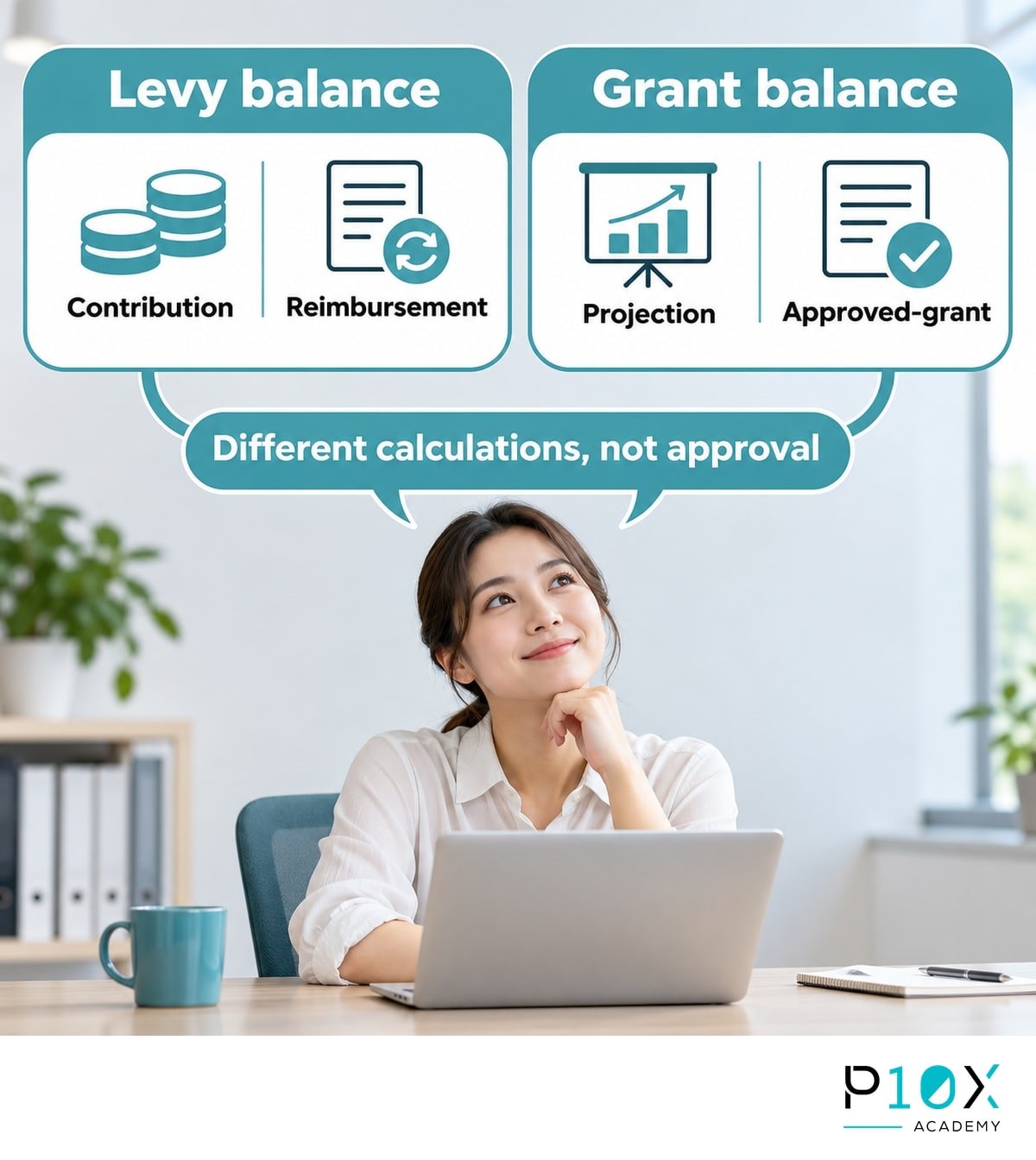
A manager who checks only one balance may misunderstand how much is available for another training application. Existing approved training can affect what is available for further applications. A projection does not mean the employer can withdraw that amount or spend it without meeting scheme conditions.
Plan training around the work your team doesOur HRDC Claimable Corporate Training offers a starting point for discussing the skills your employees need. The selected programme and employer grant still need separate checks from the levy calculation.
When checking a balance, record when it was viewed and what commitments were already included. If the finance team and training coordinator see different figures, compare their account information and dates before assuming there is an error. Payments, reimbursements and approved grants can affect the figures they are discussing.
Before applying for a course, you can check the specific grant conditions to see whether the programme and costs qualify and what the application requires. Knowing the balance can help with planning, but it does not replace grant approval. HRD Corp can explain an unclear figure before the business commits to a course or makes a payment based on an assumed budget.
What records are needed for a levy refund request?
HRD Corp’s levy or interest refund procedure asks for the refund type, reason and remarks, together with the levy month, year and amount requested. It also requires an attachment, such as a payroll summary or payment slip. Keep these records available when asking about a payment that may need correcting.
A refund request is separate from a training claim. If a payment appears incorrect, ask HRD Corp whether this procedure applies. The existence of a refund form does not mean an unused levy balance is automatically refundable.
What needs a separate check before booking training?
Paying the levy does not confirm which course an employer can fund. Before booking, check the programme, participants and relevant grant conditions. The levy calculation belongs with payroll; course selection and grant approval are separate decisions, based on the team’s work and the intended scheme.
For example, our three-day detailing course covers product knowledge, paint and interior materials, washing precautions and beginner one-step bonnet polishing. These are beginner skills. The listed topics are not a promise of advanced paint correction or coating expertise, or an SKM (Sijil Kemahiran Malaysia) award.
Our three-day course page states that tools, products, consumables and training vehicles are provided. That gives the employer something specific to compare with the quotation: what is supplied for the training, what the course fee covers and whether any other expenses are being proposed. Equipment bought for normal workshop operations is not automatically a training expense just because staff will use it after the course. If the quotation includes another item, the provider can explain its purpose and how it relates to the training before the employer checks whether the intended scheme allows it.
For the claim, keep records accurate and follow the applicable scheme requirements. The cost matrix describes the supporting documents, while HRD Corp Claimable Courses (HCC) guidance sets a six-month deadline after completion for claims under that scheme. Confirm who submits each claim and who retains the employer’s copies.
Resolve payroll questions before the next payment
If the employee count, wage items or registration position is unclear, gather the relevant employment and payroll information and ask HRD Corp to confirm the treatment. Do not guess from another company’s setup or change the rate solely because a software menu offers that option.
If an earlier calculation appears wrong, retain the original records and ask how to correct the employer account. Payroll advisers can help reconcile the figures, but HRD Corp remains the authority on its registration and levy requirements. A training provider can explain its course and supply programme information. HRD Corp confirms whether the employer must register and which levy requirements apply.
Keep contributions and course approvals separate
Before finalising the next payroll, confirm how many Malaysian employees count towards registration, which rate applies and which wages enter the calculation. Check the payment deadline and reconcile the account records. Training bookings need a separate check of employees’ skill needs, programme details and grant conditions.
That gives the business a clearer plan: pay the levy correctly, understand the balances and choose training employees can use. Do not deduct the employer’s contribution from staff wages or treat a displayed balance as automatic approval to spend.