

Key TakeawaysHide
- SKM Level 3 is a certificate. Diploma Kemahiran Malaysia (DKM) is a separate Level 4 qualification.
- Your chosen programme's field and entry requirements matter as well as the level.
- Acceptance into a diploma programme does not automatically give you credit for subjects studied earlier.
- A higher skills level does not guarantee a supervisor job or a particular salary.
An SKM Level 3 certificate recognises skills in a particular field; it does not turn every holder into a supervisor or a diploma graduate. JPK, Malaysia's Department of Skills Development, lists Sijil Kemahiran Malaysia (SKM) at Levels 1 to 3 and Diploma Kemahiran Malaysia (DKM) separately at Level 4.[1]
If you are comparing courses, you need to know what work the programme covers, whether you meet its entry requirements and what you want to do afterwards.
What a Level 3 certificate tells you
An SKM Level 3 award identifies skills in a particular occupational field. JPK describes accredited programmes by both field and level. The programme title and course content therefore matter as much as the level when deciding whether the training suits the work you want to do.[1]
Doing technical work and organising a business require different skills. A programme's connection to the motor industry does not tell you whether you will learn practical vehicle work, administration or another occupation.
The exact title and programme code in the official record give you a clearer basis for comparison. You can then compare that with the course description, learning plan and qualification on offer. A shortened name on an advertisement should not be the only description you have before enrolling.
If you are considering our SKM pathway programmes, the specific course details will help you establish which award you would receive.[2]
Is Level 3 the same as a diploma?
No. SKM Level 3 is a certificate, while DKM is a Level 4 diploma in JPK's qualification system. Being able to use Level 3 when applying for further study does not change the certificate into a diploma. Qualification level and eligibility to enter another programme answer different questions.[1]
This distinction matters when reading phrases such as “diploma pathway”. A pathway may describe what you can apply for next, not the award you receive from the course advertised. The provider can clarify the award at the end of each stage and whether the following stage needs a separate application.
JPK lists DKM at Level 4 and Diploma Lanjutan Kemahiran Malaysia (DLKM) at Level 5. Neither award is automatically included just because you enrol in a Level 3 course.[1]
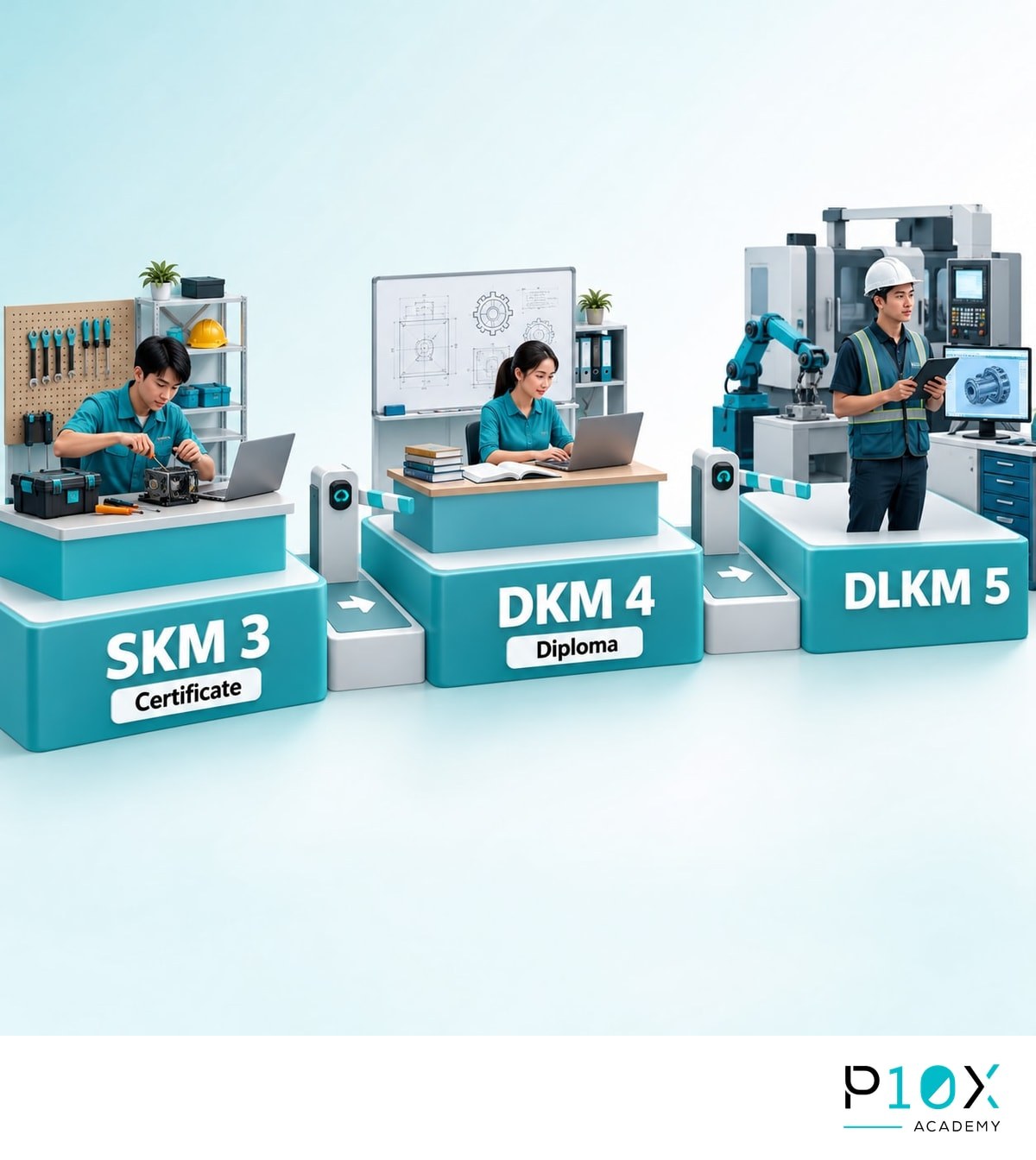
An academic diploma is another programme with its own admissions process. Some accept relevant Level 3 holders, but that is not a blanket offer for every diploma in every field. Your certificate can support an application without guaranteeing either a place or exemptions from particular subjects.
Who can apply, and which route fits?
JPK's guidance for training at a recognised institution requires a lower SKM level before a higher one in the same field. Centres may set additional conditions. If you hold SKM Level 2, your chosen centre needs to confirm whether that award meets its Level 3 programme's entry requirements.[1]
Your full qualification title and code give the centre more useful information than “I have SKM 2”. If you want to change fields, details of your previous training and intended programme will help it assess the route.
If you do not hold a lower SKM award, the exact programme's entry requirements matter more than an advertisement aimed at beginners. “No prior management experience” or “school leavers welcome” may describe the intended audience without fully explaining the qualification prerequisites.
Prior-achievement assessment is different. Pengiktirafan Pencapaian Terdahulu (PPT) is a route for assessing skills developed through earlier work or training. JPK requires evidence of competence to be assessed and externally verified. It is not automatic certification for having worked for a certain length of time.[1]
A new learner and an experienced worker should therefore ask different questions. The learner needs a training plan. The experienced worker needs to understand the relevant assessment requirements and whether their existing work provides suitable evidence. Neither should choose a route based only on a promise of getting the certificate quickly.
How to apply for a Level 3 programme
To apply for SKM Level 3, you need to know which field you want to study, which accredited programme you are considering and whether you meet its entry requirements. JPK directs applicants to MySPIKE for searches of accredited centres and programmes. Once the record and your eligibility are clear, the provider's current application instructions are more useful than an old intake advertisement.[1]
A first enquiry can include your highest school qualification, existing SKM awards, relevant experience and the programme you want. The centre can explain which documents a formal application needs and how to submit them securely. A general course enquiry does not require you to post identity documents in a public comment thread.
Before accepting an offer, you can request the programme title, intended award, timetable and fee breakdown. Knowing whether assessment, materials, equipment and other compulsory costs are included makes the total commitment clearer. If a deposit is required, the payment, cancellation and refund terms are worth understanding before you pay.
Funding should be considered separately from admission. A training offer does not tell you whether a loan, allowance or other support has been approved for you. The eligibility conditions and repayment terms will help you assess a financial arrangement without treating a promotional amount as money already available.
If your longer-term aim is a diploma, you can also contact the receiving institution before enrolling in Level 3. With the proposed qualification title and code, the receiving institution can explain whether the field is relevant to the diploma you want. That can prevent you choosing a course on the strength of a progression claim that does not fit your goal.
Exploring automotive skills training?You can explore our SKM pathway programmes and discuss which current course and application route fit your qualifications.
Training, assessment and course duration
Course duration needs to be read alongside the field, route and training covered. The level alone does not tell you how long the course takes. Useful details include whether the advertised period covers one stage or several, how often you attend and whether assessment or other commitments fall outside the stated teaching period.
Practical delivery matters just as much as the dates. Knowing which tasks you will carry out, what equipment is available and how instructors give feedback makes the training easier to compare. A programme description should help you picture what you will learn to do, not leave you relying only on broad promises about becoming skilled.
Assessment should also be explained before you begin. You can ask what you must demonstrate, how your work is judged and what happens if a requirement is not yet met. Those answers help you understand the effort involved without assuming that attendance alone is enough for an award.
JPK distinguishes accredited institutional training from assessment of prior achievement. In the latter route, existing competence and its evidence are the starting point. A shorter process for recognising existing experience does not mean a beginner receives the same training in less time.[1]
A workshop evaluation can also serve a different purpose from a qualification assessment. A training video is easier to interpret when you know what is being assessed, who conducts it and which programme it belongs to. Footage of practical work does not, on its own, establish a course's qualification level or accreditation.
If you are working while studying, the actual weekly timetable and attendance requirements will help you judge whether the course fits your job. Daytime assessments, travel and placement commitments matter too. “Flexible” is not enough detail to decide whether you can keep your existing work hours.
Jobs and further study after Level 3
Employment and further study depend on the field of your certificate and the requirements of the employer or receiving institution. Level 3 is not a universal supervisor qualification. For study, relevant DKM programmes and academic diplomas are different options to investigate; neither should be treated as an automatic place.

For work, the tasks in a vacancy are a useful starting point for comparing the role with what your programme covers. You may need to show practical ability, explain decisions you have made during training or demonstrate experience relevant to the role. A title such as “supervisor” does not have one set of duties across every occupation.
If you are applying for your first job, you can describe the tasks you practised during training and those you were assessed on, without claiming experience across the whole industry. Examples of your work can support the application where you have permission to share them, especially when they contain customer or employer information.
Employer evaluations may look at matters beyond a qualification's requirements. When a provider shows a workplace assessment, its purpose and relationship to certification need to be clear. That is more useful than treating any assessment video as proof of a guaranteed job.
For diploma study, Malaysian Qualifications Agency (MQA) explains an entry route that does not rely on Sijil Pelajaran Malaysia (SPM) results. Its FAQ states that under its progression rules for skills qualifications, institutions admitting relevant SKM Level 3 holders to diploma programmes need not assess the SPM qualification, including specified subjects. Institutions must provide suitable additional teaching to strengthen these students' skills.[3]
That guidance is a reason to ask about the SKM entry route even if your SPM results are weak. It is not permission to assume that any SKM field qualifies for any diploma. The receiving institution can identify the relevant Level 3 programmes and explain any additional teaching, interview or other application requirements.
A concrete example is the official polytechnic admissions page for Diploma in Games Art Technology. It lists relevant SKM Level 3 under its non-SPM route, alongside Malaysian citizenship and an interview or portfolio requirement. This is an example of one programme's rules, not a progression promise for an automotive qualification.[4]
Credit transfer is another question. MQA permits transfer from technical and vocational education and training (TVET) programmes subject to course mapping and current credit-transfer policy. Meeting the entry requirement does not mean your diploma will automatically become shorter. The receiving institution needs to assess exemptions separately from admission.[3]
How to check a centre and certificate
MySPIKE provides centre and programme information for choosing training, while its separate Semakan SKM service checks an individual's award. These searches answer different questions. A centre listing does not verify a person's qualification, and a person's award does not establish the accreditation of every course offered by that centre.[5][6]

For a programme enquiry, the institution name, centre code, programme title, code, level and displayed status need to match the offer. If the marketing title differs from the official title, the provider can supply the applicable record and explain the difference. A shared reference to automotive work is not enough to establish a match.
If you cannot find a match, the provider and, where necessary, JPK can help clarify it. A missing result can leave a question unanswered, but it is not enough on its own to conclude that a programme is unaccredited. A recognition claim is only useful once you know which exact record it refers to.
For a personal certificate check, the official Semakan SKM service is the appropriate place to enter your identity card details, not a public forum. If a result is missing or differs from your documents, the issuing centre or JPK can help clarify it.[6]
The course record, your entry eligibility and the next step you want give you three useful points to compare before choosing Level 3 training. A clear answer on those three points is more useful than a broad claim that the qualification leads to every job or diploma.